
 Feedback

Fitness Professional's Handbook 8th Edition With HKPropel Access
Author: Barbara A. Bushman
$109.00 USD
This eighth edition reflects the most up-to-date research, position stands, guidelines, and standards from the American College of Sports Medicine (ACSM), other professional societies, and government agencies. New case studies reflecting a diverse array of clients offer real-world applications, and Research Insight sidebars cover a wide range of applicable scientific topics.
Significant updates, changes, and additions have been made throughout, including these:
- An updated overview of assessment that provides practical understanding of preparatory steps such as obtaining informed consent, taking steps to maximize client safety, and explaining test results in a way that will be meaningful and relevant
- A new chapter on how to combine assessment results with a client’s personal goals to create a comprehensive exercise program; readers will learn how to develop the optimal training stimulus and to balance activity level and nutritional requirements to optimize outcomes and safety for clients
- Expanded content on working with clients who are pregnant, covering the benefits of exercise during and after pregnancy; contraindications and signs that warrant stopping exercise; and new content on pelvic floor training
- Updated content on chronic diseases, featuring the latest information on cardiovascular disease, pulmonary disease, diabetes, osteoporosis, and cancer
The engaging full-color textbook is further enhanced by 25 related online videos, delivered through HKPropel, facilitating a deeper understanding of techniques in the book and development of practical skills.
Comprehensive yet practical in nature, Fitness Professional’s Handbook is designed to prepare students for professional certification and empower current fitness professionals to work with various populations to improve health, fitness, and quality of life through appropriate screening, testing, and exercise prescription.
Note: A code for accessing HKPropel is included with all new print books.
Audience
A text for undergraduate and beginning graduate courses in fitness testing, programming, and exercise prescription that assume a general background in anatomy and physiology. Also a reference for health and fitness professionals and those preparing for certification with the American College of Sports Medicine or other organizations.Chapter 1. Health and Fitness Benefits of Physical Activity and Exercise
Barbara A. Bushman
Chapter 2. Preparticipation Screening
Barbara A. Bushman and Lauren R. Chaney
Part II. Foundations
Chapter 3. Anatomy in Action: Functional Movement
Clare E. Milner
Chapter 4. Physiology in Action: Exercise Physiology
Brian Parr and Barbara A. Bushman
Chapter 5. Fueling for Activity: Dietary Considerations
Laura J. Kruskall
Chapter 6. Energy Costs of Physical Activity
Barbara A. Bushman
Part III. Fitness Assessments
Chapter 7. Overview of Assessment
Barbara A. Bushman
Chapter 8. Cardiorespiratory Fitness Assessments
Barbara A. Bushman
Chapter 9. Muscular Fitness Assessments
Avery D. Faigenbaum
Chapter 10. Flexibility and Neuromotor Fitness Assessments
Erica M. Taylor
Chapter 11. Body Composition Assessments
Barbara A. Bushman
Chapter 12. Electrocardiogram (ECG) Assessment
Brittany Overstreet
Part IV. Exercise Prescription
Chapter 13. Exercise Prescription for Aerobic Fitness
Barbara A. Bushman
Chapter 14. Exercise Prescription for Muscular Fitness
Avery D. Faigenbaum
Chapter 15. Exercise Prescription for Flexibility and Neuromotor Fitness
Erica M. Taylor
Chapter 16. Putting Together a Comprehensive Program
Barbara A. Bushman
Part V. Special Populations and Conditions
Chapter 17. Youth
Avery D. Faigenbaum
Chapter 18. Older Adults
NiCole R. Keith
Chapter 19. Pregnancy
Barbara A. Bushman
Chapter 20. Weight Management
Tanya M. Halliday
Chapter 21. Chronic Diseases
Barbara A. Bushman
Part VI. Exercise Programming Considerations
Chapter 22. Behavior Modification
Janet Buckworth
Chapter 23. Injury Prevention and Management
Jenny Moshak
Chapter 24. Legal Considerations
JoAnn M. Eickhoff-Shemek
Dr. Bushman is a fellow of the American College of Sports Medicine (ACSM) and holds four ACSM certifications (Personal Trainer, Exercise Physiologist, Clinical Exercise Physiologist, and Program Director) in addition to the Exercise is Medicine credential. She has been very active within ACSM, serving on the Membership Committee; Certification and Registry Committee; Women, Sport and Physical Activity Strategic Health Initiative; and Media Referral Network, among others. Within the Central States Chapter of ACSM she has served as president and secretary-treasurer and has served on several committees.
Dr. Bushman has been involved in numerous book projects, including being the lead author of ACSM’s Action Plan for Menopause; associate editor of ACSM’s Resources for the Personal Trainer, Third Edition; senior editor of ACSM’s Resources for the Personal Trainer, Fourth Edition; and editor of ACSM’s Complete Guide to Fitness & Health, First Edition, and ACSM’s Complete Guide to Fitness & Health, Second Edition. She has been an associate editor of ACSM’s Health & Fitness Journal since 2011 and writes the “Wouldn’t You Like to Know” column, which covers a wide range of topics of interest to fitness professionals.
Over her lifetime, Dr. Bushman has maintained a regular exercise program; she enjoys running, cycling, and resistance training. Leisure pursuits include hiking, open-water kayaking, and, more recently, woodworking. She and her husband enjoy walks with their two German shepherds, who have been her faithful office companions during the work on this textbook.
Fitness Testing and Program Design
Marketing and Motivational Strategies for Early Stages of Change
Selecting Fitness Tests to Use with Clients
 Avoiding Error in Resting Measures of Blood Pressure
 Cardiovascular, Metabolic, and Renal Diseases
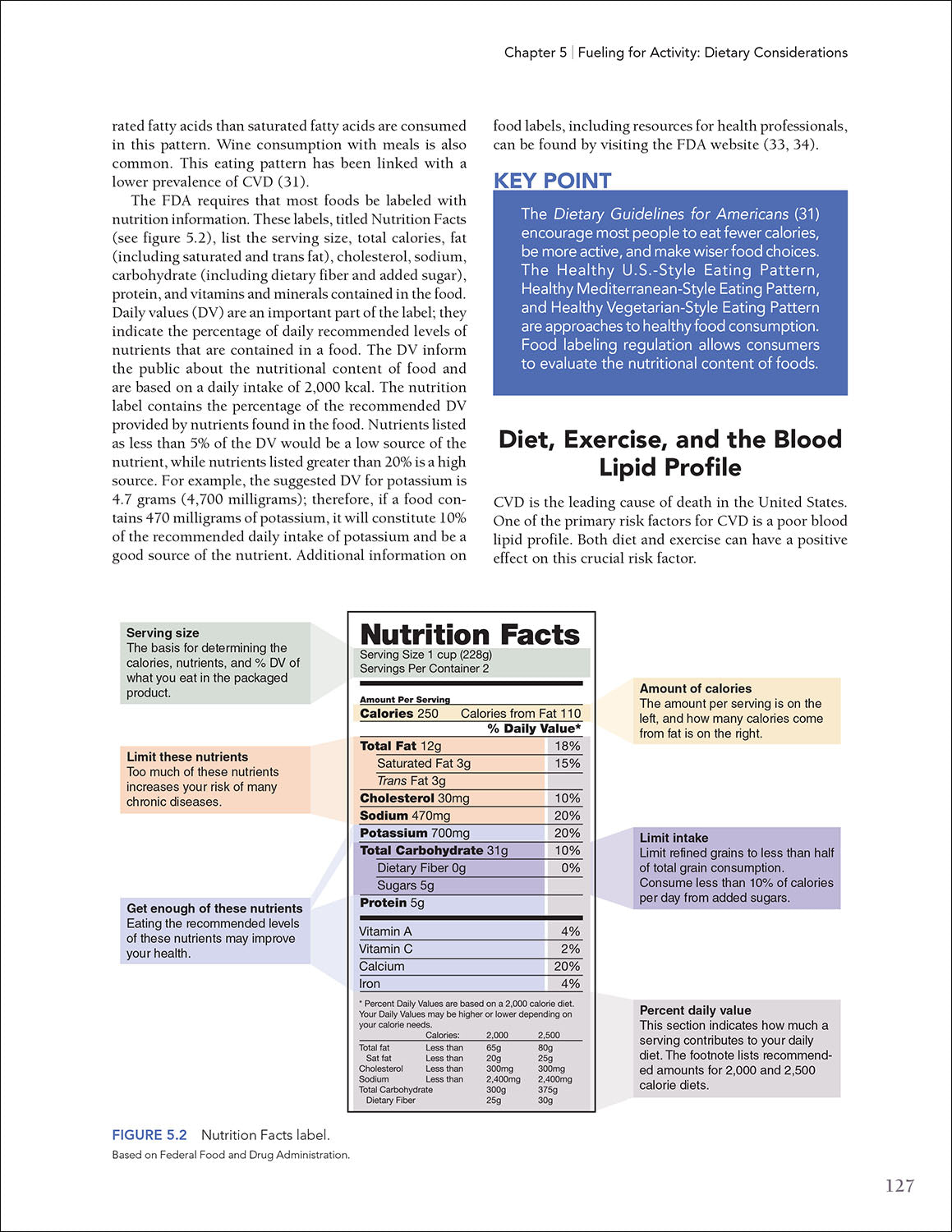 Diet, Exercise, and the Blood Lipid Profile
 Planes and Axes of Movement
All ancillaries are free to adopting instructors through HKPropel.
Instructor guide. Includes a syllabus; a course outline that details lecture topics, labs, and classroom activities; and five lab report data sheets with corresponding grading sheets. Also included are eight checklists for evaluating practical laboratory testing skills:
- Cardiorespiratory: resting blood pressure checklist, exercise blood pressure checklist, and electrocardiogram (ECG) checklist
- Cardiorespiratory fitness: YMCA submaximal cycle ergometry checklist
- Muscular fitness: push-up checklist
- Body composition: skinfold assessment checklist
- Flexibility: sit-and-reach checklist
- Neuromotor fitness: standing reach checklist
Test package. Contains 720 questions in true-false, fill-in-the-blank, essay, multiple-response, and multiple-choice formats. The files may be downloaded for integration with a learning management system or printed for use as paper-based tests. Instructors may also create their own customized quizzes or tests from the test bank questions to assign to students directly through HKPropel. Multiple-choice and true-false questions are automatically graded, and instructors can review student scores in the platform.
Chapter quizzes. Contains ready-made quizzes (10 questions each) to assess student comprehension of the most important concepts in each chapter. Each quiz may be downloaded or assigned to students directly through HKPropel. The chapter assessments are automatically graded, and instructors can review student scores in the platform.
Presentation package. Features more than 800 PowerPoint slides of text, artwork, and tables from the book that can be used for class discussion and presentation. The slides in the presentation package can be used directly within PowerPoint or printed to make handouts for students. Instructors can easily add, modify, and rearrange the order of the slides.
Image bank. Includes most of the figures, content photos, and tables from the text, sorted by chapter. These can be used in developing a customized presentation based on specific course requirements.
Instructors also receive access to all student materials in HKPropel. For Fitness Professional's Handbook, this includes a library of 25 video clips that correspond to key techniques covered in the book, particularly those that benefit from demonstration in video form.